

OLIVIA BOUDET
The Clarification
Very early on, Olivia Boudet defined the horizon of her pictorial activity by setting it in the problematic aftermath of Malevitch’s final paintings.
One may recall that the landscape stands out from the plane cut by the horizon. The image then removes itself from the world in the poverty of a secular icon for which it no longer has any face other than outlined and obliterated by the rudiments of blind geometry.
In Olivia Boudet’s paintings, the face therefore points to an insurmountable crisis of painting. But if it demonstrates the scruples of an allusive image, it is only to shift the emphasis from the sober interweaving of regular surfaces.
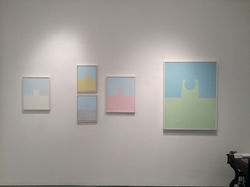
These bright buildings outlines (houses, rooftops, towers, chateaux, etc.) are like the shadows of a constructivism that has sunk back into childhood, while at the same time providing an indirect but luminous reduction method for ruling the bi- partition of a surface.
Beneath this perfunctory, but definitely cathartic idealism, there no doubt lies a certain nostalgia of metaphysical works, from de Chirico to Morandi, and of luminous subtleties, from Agnes Martin to Robert Mangold.
But these portraits of nothing but a dividing line, these empty planes hiding no secrets, demonstrate the soothing obviousness of pure derelictions and songs without address.
Through Shapiro, then Spalletti and Kiecol, sculpture has already exploited this mute rigour, haunted by soft melancholy, where the real and its counterpart, no longer representable, are able to establish a fragile and furtive clarification.
Christian Bernard
 |  |
|---|---|
 |  |
 |  |
 |  |
 |  |
 |  |
 |  |
 |  |
 |  |
 |  |
 |  |
 |  |
 |  |
 |  |
 |  |
 |  |
 |  |
 |  |
 |  |